
September 2021 update: Google have decided to give us some of this data back! What that means for the article below is, we think Google have exactly the same long-term plan as before, but they don’t quite have it working as well as they’d hoped by now. So they’re going via themes/interests to make us target that way first (audiences scale better than search volume for Google) before eventually pulling the rug and leaving the machines in charge. Let’s wait and see.
As if 2020 hadn’t given us enough to deal with, the de facto OGs of PPC advertising have stepped up to the plate and well and truly twisted the knife. I’ve mixed my metaphors there but I’m not changing it. There’s too much to talk about.
“Starting September 2020, the search terms report only includes terms that a significant number of users searched for, even if a term received a click. You may now see fewer terms in your report.” Not my words, but those of Google. Read on for the plain-English translation.
Basically, if Google deems a search term too low-volume, they just won’t show any data for it in the account if they don’t feel like it. This isn’t a small change either; I’ve seen as much as 40% of click volume and 80% of impression volume go missing in a B2B account we run at BFBC, and in another one we’re missing seventy-five percent of our converting search terms at the account-level. Google say it’s because the searches are low-volume, but if these people are actively trying to engage with our client’s business, why does that even matter? It hasn’t for the last 20 years, so why now?
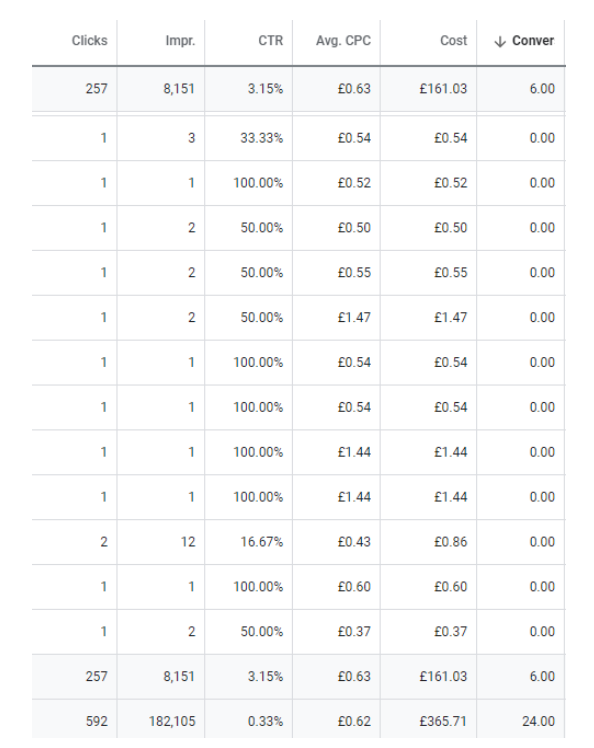
18 out of 24 conversions (in a week) we’ll never know the source of. Not great. Welcome to 2020.
It’s not the first time Google has taken data from us: about this time last year the Average Position metric was removed, to the fury of many. I didn’t count myself among them. Changes to the search result page meant the metric had lost all meaning (position 1 could mean about 3 different things by the end), and people were inferring things from it which weren’t really true anymore. Much ado about nothing. Keep adjusting bids, keep optimising your performance. We even got some shiny new metrics much more suited to the 2019 search landscape so it felt like a bit of a win.
This year’s change is not the same as last year’s. This has not been an exchange of the old for the new. The data we’re losing hasn’t ceased to be useful, nor would it probably ever have. This isn’t the removal of a red herring, or streamlining of a bloated process.
It’s closer to sabotage.
Imagine running a shop and knowing how much money you’d made, but your staff refusing to tell you what you’d sold. You’d sack whoever was in charge of reporting and hire someone competent.
Search term data is infinitely useful; it tells you what to double down on (both in paid and organic search), what to avoid bidding on, the language being used by your users so you can follow suit in your ads and website copy; it’s the backbone of traditional paid search management.
If you’re really switched on, you’ll be analysing n-grams (strings of words in a row) to find how groups of words affect performance when they appear for more intelligent negative keywords (imagine the difference between “free” and “free trial” for your software product).
What Google has done, in no uncertain terms, is needlessly obfuscate that data and limit those possibilities. They’ll tout reasons around privacy (hence the justification being search volume), but in truth they’ve just taken away some of the most important data in a Google Ads account with no fair cause.
The reason is probably quite simple. And at least a bit sinister.
What’s In It For Google?
Best case scenario? Our constant addition of negative keywords is messing with some clever automation Google are cooking up, which needs the freedom to bid on searches which are negged out (that’s cool PPC speak for being excluded by a negative keyword) when in fact they would convert and make us more money. They’ve already been sneakily ignoring negative keywords at times if conversion likelihood is deemed high enough, so clearly (to my eyes) the aim here is to stop us finding out about it as it happens more often. Once you consider that, the “well-meaning” argument loses traction.
If all my accounts see massive performance increases, I’ll eat my words and kneel before the machine learning gods. But not a moment before. And I don’t expect that moment to come. So we come onto the more daunting of the two arguments:
Negative keywords reduce spend.
Impeding us from adding them therefore increases the potential for spend. That’s a clear incentive. But why do it now?
Alphabet, Google’s parent company, reported its first revenue decline in history for Q2 2020. Search revenue dropped by $2bn vs the same period in 2019, contributing to a 2% decrease in overall revenue. Search is a huge proportion of their revenue, and always has been.
If Alphabet is going to hit their revenue goals for 2020 and keep shareholders happy, they need a great Q3 and Q4. Given that most of their revenue comes from Google search, the pressure’s on to ratchet ad spend up well above where the trend line is currently heading.
If you make it harder to add negative keywords by giving ad managers, and their automated solutions, less data to work from then less of them will be added to accounts. Consider Google’s own claim that 15% of daily search volume has never been searched before and it makes sense that we’ll never run out of stray queries to exclude. Without the ability to exclude them, progressively more money will be spent on clicks that aren’t worth it. Unless your accounts are close to perfect already, waste will creep in.
Advertisers with deeper pockets will increase budgets to maintain lead volumes. Those without will have to live with less volume. People will generally end up spending more, Google makes more money, it’s all very straightforward. It’s not very “don’t be evil” though. I can see why they dropped that motto. Early reports are also showing higher average CPCs for the data we can’t see compared with the data we can? Maybe those will creep up over time too, especially if all our conversions are hidden to daren’t drop our bids.
Looking even further into the future shows us the strongest incentive of them all.
The Long Con
Recently I’ve been reading In The Plex, which for the uninitiated is basically a biography of all things Google: how it started, how the world-beating search algorithm came to be, the way the company culture was formed, expansion into non-search areas, you name it. There was a little paragraph about the invention of Google Ads which really stuck out at me when I read it:
“[Larry] Page was adamant that the system be simple and scalable. He thought that the system should be so easy for advertisers that all they would need to do was give their credit card number and point Google to their website.”
It then went on to say he thought advertisers shouldn’t even be involved in choosing keywords, among other things. You can see where they’re going here.
Every bit of control; keywords, bids, audiences, right down to ad copy, is just a way to make the system work for us until there are enough clever automated mechanisms in place to get back to that original vision:
Give us your credit card. Tell us your website. If you’re an agency, fuck you.
Every day we use the platform, we’re digging our graves to pay our bills. The data we use to do our jobs is analysed by Google, so they can use it to teach those same jobs to a machine. Let’s not get too down about it; PPC is far from the first industry to suffer such a fate. And we have an edge that someone in say, manufacturing, does not. We’re in luck.
However advanced, machines have limits. They can simulate thinking and logic, but they can’t simulate feeling. Even with all the data in the world, Google can’t teach a machine empathy the way you’d teach it to manage bids or targeting.
It’s time to change the way we do things. If your Google Ads acumen comes from number crunching and PivotTable mastery, it’s time to learn about your customers again. If your idea of a split test involves swapping headlines 1 and 2 in your generic text ads, you need to spread your wings.
The machines will manage bids for us; they’re already very good at it if your accounts have the scale they need. This frees up time to do product and customer research, to write ads that speak to your target the way they want to be spoken to, to read up on the competition…
To do the things advertisers have been doing since ads were invented.
Google is the odd one out among ad platforms by offering such granular bids and keyword targeting in the first place. Facebook barely had either to begin with. TikTok isn’t about to add them in. Best practice for those platforms is to avoid diving into settings and tweaks at the first sign of performance slipping. And yet it’s possible to be very good, or very bad, at Facebook Ads. The difference is in copy, creative, messaging, positioning, audience selection; the things marketers have been dealing in for more than a century.
Digital marketing is not under threat. But if you’re a number-cruncher (and I say that as a Mathematics BSc myself) stuck in your ways, you just might be.
It’s time to learn how people think. Why they do what they do. What informs their decisions? People have dedicated their lives to studying this stuff, and conveniently they’ve published their findings. Read Ogilvy On Advertising, Thinking Fast And Slow, and build up from there. Let Google automate the boring bits and learn to actually be creative with the time you win back.
We still have more data, and more ways to process it, than Ogilvy, Hopkins or Collier could have ever dreamt of. We can still measure every test and change with painstaking accuracy. We can take the old ways of doing things and refine them to a point which was impossible even as Ogilvy, the youngest of the three aforementioned masters, was laid to rest. Let the corporations automate our bids and targeting. Stand out based on messaging. Don’t be the most relevant through boring copy that fits an algorithm. Be irresistible by showing your understanding of people’s wants.
As PPC managers, we’re not preparing for the credit card/website eventually Larry has wanted for two decades. We’re adapting our approach so when it comes, we’re already onto bigger and better things.
Google Ads is unique in that you can succeed in it by crunching the numbers hard enough to get around not being a very good marketer. I really think performance marketing will be a flash in the pan and by 2025 we’ll be asking “hey, remember when those people with no empathy or understanding of how we think could make a fortune marketing because they were good enough at spreadsheets?” It’ll seem ridiculous after the fact.
Once more- Digital marketing is not under threat. But if you don’t change the way you do things, you just might be. This new, stunted search term report isn’t the one Google Ads managers will have to live with in the 2020s, but rather the best we’re going to get this decade.
Experienced SEOs the world over (including our very own here at BFBC who deserves full credit for this comparison) will be able to remember when you could get nearly all the organic search term information you’d ever want from Google Analytics. It was slowly taken away until here in 2020 you can get about 1% of it, which bodes poorly for those of us who prefer to pay for our place on the SERP.
On the bright (possibly a bit ambitious in my word choice there) side, it gives us a reasonable prediction of what’s to come. Which is to say that the SEOs who are still complaining about the loss of these search terms and refusing to fully adapt to life without them are probably the people we don’t want to end up becoming the PPC equivalent of.
Rather; we know this is just the start. We have a decent idea of where we’ll end up. The struggles on the horizon are predictable, if still really inconvenient. The changes in the SEO landscape are a great early warning. And what has Google been telling SEOs for years?
Optimise for people, not robots.
All I’m trying to say is, the same needs to apply to PPC. It always should have, but now the robots are optimising you out of a job. The illusion of choice for us is gone. Give your customers a real one.
