Pmax Channel Reporting and the success it never was
Google has released channel performance reporting for Pmax. It was all their idea. They thought of it.
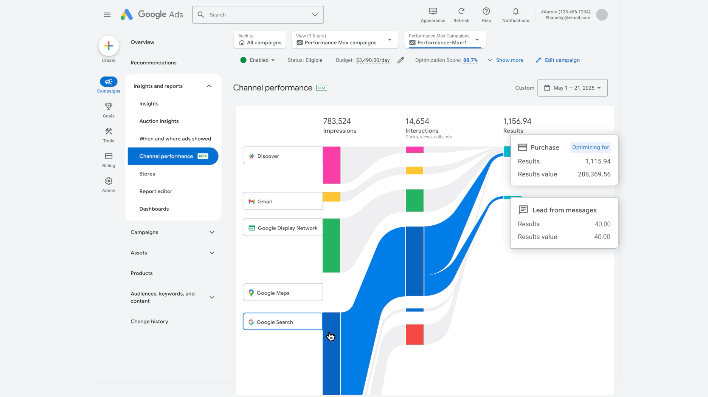
(image from Google Channel Reporting on Google Ads Blog)
Where is Pmax reporting?
Pmax reporting is called Channel Performance Reporting and you can find it in the left hand column under insights and reports > Channel Performance reporting.
The reporting still has a ‘Beta’ tab next to it, and we can only hope that this means they’re still working on the functionality and transparency of the reporting.
Worth noting that we have only found this on some of our accounts and it’s not yet available in all accounts.
Despite the UK’s DMA (Digital markets act) having mirror legislation in the EU, we haven’t spotted the reporting feature yet in any EU territories we actively manage.
Why has Google introduced Pmax reporting?
Despite Google’s claims which sound a little like this ‘ You asked, we listened’, this is most emphatically not the case. Google have been forced to release more advertising data to advertisers due to the Digital Markets Act which states that Gatekeepers (Google et al) must allow advertisers to make an independent verification of the effectiveness of their advertising campaigns, hence the Channel Performance Reporting
How effective is Channel Performance?
It’s important to note that Channel performance reporting is still in Beta and it’s pretty basic. Currently we can segment PLA spend from other asset spend, but what’s hidden is how the residual cost was divided between search, display and Youtube.
Channel performance reporting now contains a table with cost per platform and conversion value. They haven’t included roas as metric in the columns for some reason. But that’s simple enough to calculate
Roas = £revenue from ads / £ad spend
Anything new?
I don’t think this tells the advertiser anything they didn’t already know, but it has shown that even campaigns without assets are still being served on placements despite best efforts to avoid this. Reporting shows a differentiator between two types of ads.
Ads using product data (shopping feed ads)
Ads not using product data (display, text, video)
In campaigns without assets, Google is still inexplicably managing to serve ads without product data, without any assets?
It begs the question, what are they serving?
How could advertisers use this data?
Well, with what’s on the horizon, I think advertisers will have few options to optimise campaigns for performance based on data. I believe there will be two options at account level
Option 1 – all in and let Google do and serve what it wants, where it wants and spend what it wants
Option 2, Opt out as much as possible and run manual campaigns on shopping
Following an update in the platform on the 7th of May, Google opted all, previously opted out, advertisers back into the automated assets ecosystem. The purpose was to gather as much data and assets to assist with AI Max for Search – which is bloody awful, don’t do it. Read more here about AI Max for Search
And while it’s great having this information, without the ability to choose to restructure the Pmax campaigns and opt out of various elements, how effective is it?
Google, This COULD have been incredible! What a waste!
How fantastic could this data be if Pmax was updated in line with this new information to give advertisers the ability to tweak the Pmax channels?
Pmax is made up from the following elements
- Discovery
- Display
- Gmail
- Maps
- Search (including shopping)
- Youtube
Now imagine if you used the available data to opt out of certain channels
Along with the ability to assign bid adjustments to the one you’ve opted into
A new Pmax campaign structure could look like this
- Search (shopping)
- Discovery
- Display
- First Party Data, In-market audiences, Affinity audiences – Display & Discovery only
- Test 33/33/33 split in budget
But without giving advertisers the ability to optimse campaign segments and budget adjustments, it’s just numbers and the only choice you have is running with no assets or manual campaigns.
It’s such a shame when you think of all the variants, tests and different campaign structures you could have had using this data. Pmax could have been incredibly exciting and the PPC community would have tested this to the limit. Alas, it was a knee jerk rection to a legal ruling and the only future we have to look forward to is AI Max or manual. It’s a bit like choosing between Alien or the half human half Alien baby it has in the last film. Meh.
I’ll leave you with Bullseye circa 1980. Look at what you could have won!
PPC & love ♥️