
Email marketing gets a bad rap these days because people get it wrong a lot; even the big guys.
In actual fact, it turns your ecomm store up to 11 and makes your other marketing way more profitable by winning more customers, retaining them for longer, driving them to buy more often and spend more each time they shop with you. Larger customer values mean you can pay more per conversion in your paid advertising; that lets you scale your budget further and compete more aggressively. Then you’ve got more customers who are all spending more.
All that considered, you can’t afford not to be doing it.
Thanks to the rise of texting and instant messaging (miss you MSN) in the 2000s and the absolute dominance of Facebook and WhatsApp in both of those spaces in the 2010s, we’ve entered the 2020s (maybe we can write this year off and start the decade over too?) with email being relegated to something most of us associate with work and impersonal contact from big companies. The impending mountain of Black Friday emails will make a fantastic example when they swarm your inbox later this month.
For marketing, this change has had a not-so-great downside; it’s easy to get email wrong and just be part of the spam that litters people’s inboxes:
While the subject is indeed bald, I didn’t actually draw this comic myself. I just relate to it a lot.
This isn’t any reason to give up on it, though. Millions of people are running online stores and advertising on Google and Facebook, but that’s never stopped you right? Something makes you different, better, or ideally both. Better still, email is rife for personalisation, and that goes down a treat these days. And remember, when you do it right it gives you more everything. You do want more everything, right? I know I do.
We’ll run through the basics, and when you’re done reading you’ll have a solid idea of how to get started.
Subject lines; the bit where you give people a reason to care
We all know that one person who can make the most exciting of statements fall flat, give you a piece of information in a way that totally undersells it, who can’t ever do a good story justice or get their jokes to land right.
Don’t let your emails be that person.
The difference between “Sale Ends Tomorrow” and “Last Chance For Huge Savings” is subtle, but the second one will grab 90% of people much more strongly than the other. For one, it doesn’t sound like every TV sofa ad ever. More importantly it adds scarcity into people’s thought process. It’s far too easy to leave an email until later especially when you’ve got until tomorrow, but when it’s your last chance? FOMO takes control. You’ve got to read it. Who knows what you’ll lose out on if you don’t? It said the savings were huge. Better not find out.
Before you even get that far, you have to overcome the delete button embedded into a notification on most phones:
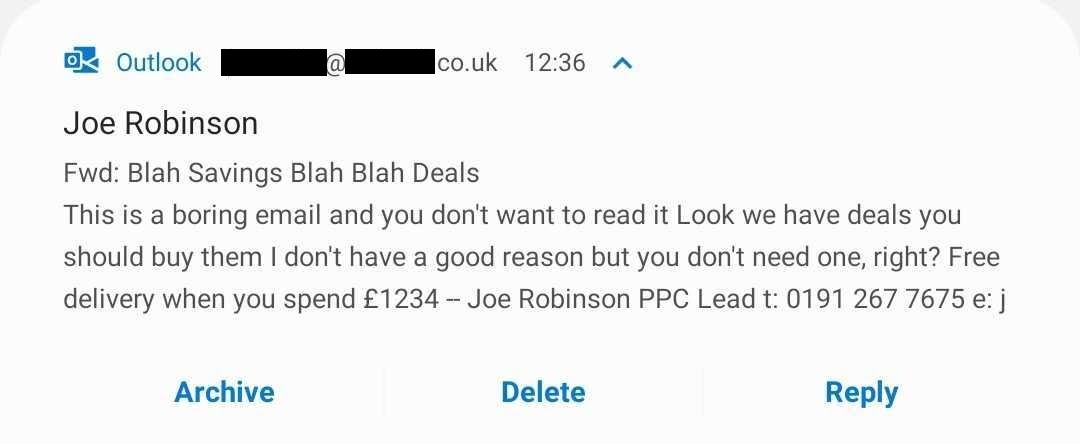
“Wow Joe”, I hear you cry. “Please tell me more. I’m throwing money at the screen but nothing is happening.”
The same best practice applies in every other context: an email with the subject “Newsletter Signup Successful” probably won’t even be read by 90% of people (it doesn’t even sound like a human wrote it), but “Welcome To The VIP List” is going to make people feel a little bit special and have them checking for bonuses and further flattery. Remember, 2020 email is usually boring and mundane. If you lead with what’s in it for the reader when they open yours, they’ll be much more willing to give you the reaction you want. It’s a win-win.
Keeping your promises; put their money where your mouth is
Their phone buzzed, the headline was saucy enough to save the notification from being swiped into oblivion. They’re reading. The ball is very much in your court. This is the ecommerce equivalent of being down on one knee. Only with a much higher chance of failure. “Please don’t make a scene” doesn’t really work on disappointed customers.
This is where you have to make good on whatever you’ve just said to get their attention. If you underwhelm, you’ll end up worse off than where you started. There are a few best practices here, then it’s going to depend on who’s received the email and why. See, personalisation.
- Check how it looks on mobile. If I had to guess- and I do because I don’t know you, but my DMs are always open- you plan out your emails on a PC. Then you send them to hundreds or even thousands of people, who will mostly open them on a mobile. I’ve personally seen this done poorly both ways round, cramped mobile layouts or a genuinely traumatic desktop experience to allow for a decent mobile one; it’s possible to get both right. Customers will thank you. With money.
- Use their name if you can. Use their name. As an A-level student I was there when my entire year group got a happy birthday email from the same uni on the same day. Not a good look. If you actually have the right info, people can’t help but be gripped by it. Deep down we all have an ego.
- Tailor the products in the email to their previous purchases/browsing. If you’re going after basket abandoners, this couldn’t be simpler: show them what they left behind. For other people, try for a post-purchase upsell or a cross-sell later. This can be as simple as related categories; if they bought a pair of boots and they’re obviously prepping for cold weather, send them an email with your top five coats, hats or scarves in it. Automate the sequence in September and you’ll be counting the cash until Christmas.
- Make it easy to say yes. If you’re showcasing a selection of products, make sure they’re all linked directly to the right product page. If there’s a “browse the collection” button, make sure it goes somewhere sensible. Don’t send them to the homepage to find their own way. It will fill them with rage. Nobody ever bought anything out of rage.
- Consider discounting, but don’t rely on it. If you’re going after basket abandoners 10 minutes after they left the site (sounds annoying but people just forget, give reminding them a try), don’t throw away a chunk of margin on a discount they didn’t need. If it’s been 24 hours, or you’re trying to re-engage someone who hasn’t bought for 90 days, maybe give them a little sweetener. Show them you care.
Likewise, don’t always discount if they leave their basket. People grow to expect it and leave a basket on purpose to wait for the code. They consider it a money-saving tactic. If it always works, they will be smug and you will be poor. Don’t fall for it.
If you get this stuff right, and make sure to spell everything correctly (people will Tweet at you if you don’t so this is doubly important), you’re well on your way. Write it like a person; be on-brand! It needs to feel like it’s from you. If there’s a person who acts as the face of the business, emails should be in their tone of voice and addressed from them (possibly not in the literal sense, you might not want replies going to your Managing Director).
As for how to decide who gets what? There are some basic rules of thumb, and after that it’s going to very much depend on your business. Here are the big three that will set you head and shoulders above everyone else:
- Remarketing. I already touched on basket abandoners, and if you have a way of sending browse reminders too then there’s certainly no harm in testing them. If you’ve got their email, try it both ways. If you’re remarketing on Facebook too, make sure the messaging matches. Again, it’s got to feel like a person is doing this. People buy from people, not algorithms.
- Post-purchase upsells/cross-sells. Your order confirmation is usually your most-read email, and they’ll often be opened pretty quickly. If you put a very limited (I’m talking hours, not days) discount code on their next purchase, with a few choice suggestions for what to buy, there’s bound to be some uptake. If you have the means to make it happen, give people the chance to swap their purchase for a more expensive version of the same thing. If they do it fast enough, it won’t affect their dispatch time. They will love you.
- Re-engaging lapsing customers. If you know people tend to buy three times, have a plan in place for after that third purchase. If they’re buying once a month, that’s got to be enough time for you to have some new products to show them. If you’re in fashion, there might even be a whole new season’s worth of stock. Again, think about related categories. More of the same might work, but it depends on your offering. Don’t follow the lead of Amazon. I know I bought a laptop last month but that’s the exact reason I don’t want one this month. Try to sell me a mouse or something. Be smart with your recommendations.
If you can get all of that in place and working, you’ll see massive improvements in your conversion rates and your customer LTVs; those are some of the most important numbers in your business, especially if you’re paying for traffic. Once you’ve pulled it off and you want to go big, get in touch and we’ll dream up your next big idea. Or you don’t fancy pulling it off by yourself, getting people in your position started is what we do best. There’s something for everyone.
