
The name of the game is selling your stuff through search engines? If you can’t be found when someone is actively looking for the stuff you sell, then you’ll certainly never be chosen.
We’ve some serious experience in the lingerie sector, which we know performs great from a search marketing perspective. So, here’s a dive into the SERPs of the luxury lingerie world where we find some winners and losers, and hopefully you will pick up a thing or two which will help you sell more of your products online.
Keyword #1: “Prima Donna Lingerie”
Prima Donna Lingerie is a great brand in it’s own right. Selling via its own store, and also via countless third-party retailers. But who is selling it the best via search?
The SERP
NOTE: Though it is impossible to see a 100% accurate ‘anonymous’ Google search, we repeated this search from a number of different devices and locations to try and ensure fairness.
If you’re a customer looking for Prima Donna lingerie, you’re likely to end up Rigby & Peller! As you can see, they dominated the carousel of most of the searches we performed.
Digging even deeper, Prima Donna themselves don’t even occupy the #1 ranking spot — that lies with bellelingerie.co.uk, another popular retailer.
Finally, we get to Prima Donna — although Google still isn’t sure which site to offer us and perhaps this compounds the decision to not rank #1.
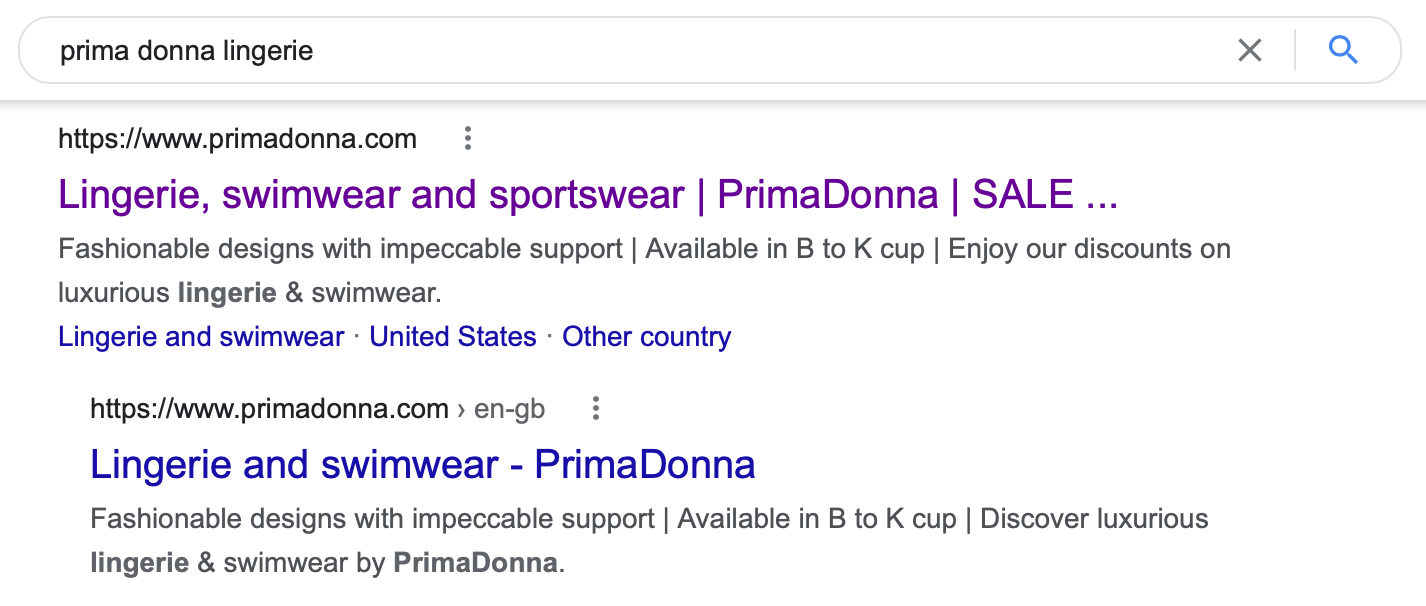
Do we need the EN-US site? Or to decide for ourselves? This search was done in the UK, with a UK IP-address, using a signed in UK Google account. How many customers land on a US site and assume the products can only be bought in the US, never to seek them out again?
A brief word on USP
Only one of the results here actually mentions Prima Donna’s main USP — did you spot it? Despite all of the ad copy written, meta titles, and description characters offered, only Prima Donna themselves are stating that their brand is best known for larger cup sizes.

Crucially… does it fit?

The above problem is mirrored in many of the carousel results — the very first item for this search drops the user on a 34B product page. While it can’t be ascertained from the image alone, the product looks unlikely to be a 34B model shot.
Concerns around fit are of critical importance to a lingerie retailer.
At a CPC of up to ~£2.40, this might be marketing spend wasted, and the feed could surely be better optimised towards the most common sizes. A click through to this page reveals this item only exists in the feed as a single SKU that is out of stock in all sized but one. This is likely a large waste of PPC spend on a single product that will be unobtainable to most visitors.
Missed opportunity: People also ask
A keyphrase such as ‘prima donna lingerie’ suggests a user who is aware of the brand but hasn’t yet found a perfect garment.
Google knows that this type of search often means additional validating searches — see how Google defines ‘the messy middle’ here — and therefore offers some additional questions which users likely go on to ask, such as ‘is prima donna worth the money’.
Interestingly, none of the retailers we see advertising on this term feature here. Instead we see links to Amazon reviews (barely useful or trustworthy at best), a USA-bsed website, and quite unhelpfully, a link to the brands Wikipedia page.

The main takeaway here is that in an semi-informational search like ‘prima donna lingerie’ there are many opportunities to gain trust with users through soft content. If you can answer some of these questions in an informative and persuasive way, there is a great opportunity to become the retailer when that searcher goes on to buy.
Google provides this information there for everyone — here are several related searches which could be answered by Prima Donna themselves, or any of their resellers. Google tends to favour diversity in these results, so we see an array of answers from different websites in a range of spaces.
Keyword #2: Marie Jo Tshirt Bra
What about a more specific ‘I want this product’ type of search?
Again, this result is heavily dominated by paid ads, in particular the shopping results which showcase the product and put the price front and centre. Rigby & Peller again perform well with superb visibility in many of the searches we performed.
Search Ads
As with the branded search above, none of the search ads are particularly interesting or offer a search really specific to the query. Marie Jo themselves have capitalised on their brand name bidding, while Varley lead with at least the product category, and a big 30% discount. There is ample scope here to show some content specific to the actual keyword, and incorporate the USPs we mentioned above.
Organic Listings

Marie Jo themselves rank best, and lead the user directly to the right category page. As we see with a lot of the meta description content, it doesn’t really capture the user’s attention other than to say ‘you’ve found the right page’. How about mentioning the brands USPs, such as its ‘perfect fit’ approach? Or information on delivery, or service?
Structured Data
One area in which Orchid Lingerie get ahead of the pack is their use of structured data. While this search might not yet have a specific product in mind, their ranking pages shows at least a price of £78.90 and a stock availability, which can at least give the user a ‘thereabouts’ price. This is a distinct advantage and proven to drive higher click through rates.
This has to be used with price competitiveness in mind, however, as it can send the user to a competitor.

If My Eve Lingerie are offering at least similar products for £45, that’s surely a more tempting prospect than clicking one for £78 — even if the products themselves are completely different.
Finally, we see Belle Lingerie, one of the bigger names in the market, showing a product code or similar within its meta title ‘0122136’ meaningless information to a customer, and wasted space that could be used to attract the click, or entice the searcher instead.
On-site experience
Lingerie Outlet Store
What do you think of when you think of “outlet store”?
You’re after a store with a whole load of choice and potentially some good deals too, aren’t you? It’s easy to convey this in a big bricks and mortar store with a few easy signs and rail after rail of stock, but to get the “outlet store” feel across on a website is tough to execute.
LOS have done a good job of this. The homepage greets you with a 20% offer, and the products listed on their display their cut price with a strike through the RRP. So top marks on the ‘deals’ part of the equation.
The range looks decent too. With a quick flick through the menus, the size selector and a large search box, the homepage gives the feel that the store has a lot of choice. Folks arriving to this site from search will no doubt feel “yep, I’m in the right place”.
While this is a simple and easy remarketing message to produce, I got a poor remarketing ad that didn’t do much to persuade me.
Additionall, this browse abandonment pop up leaves a little to be desired. I mean, it’s a bit of a long shot isn’t it.
I’d be going for a broader, more emotional appeal, 20% off the biggest names in lingerie… Something like that. Can you tell I’m not a copywriter….
This just skims the surface of what is required to compete and dominate the ever-more competitive online lingerie space. But if you can at least can be found, and be chosen, you’ve won half the battle already.
Want to discuss how we can helpk you do that? Send me a message.
